Top Reads: March 2026
AI dilemmas, miracle drugs and balcony solar.


1. The Omnipotence Dilemma
Ness Labs | 5 minutes
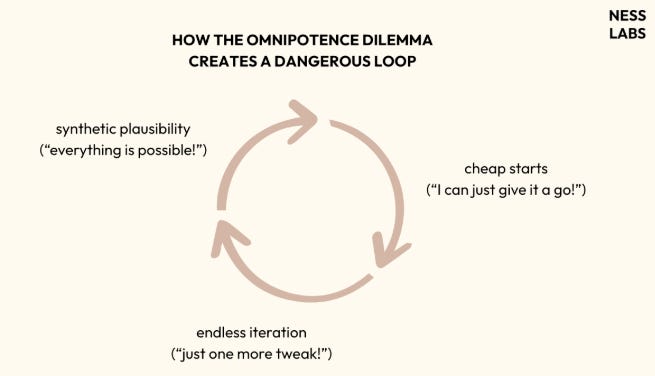
While not everyone has access to AI, those that do may feel overwhelmed – or take shortcuts. Take the time to think critically, develop a hypothesis and time-box a minimum viable test. The core fundamentals of build, measure, learn still hold.
“The deeper cost is that you outsource the hardest but most important part of creative work: forming a view. What becomes scarce is no longer skill or access. What becomes scarce is attention, conviction, taste, trust, time, and responsibility. And what worries me the most is that this cost shows up slowly. Projects that don’t quite make sense. A subtle loss of our ability for strategic thinking and meaning-making. Being unable to articulate why in the first place you’re doing this work.”
2. The Legibility Problem
Asimov Press | 14 minutes

What happens when we no longer understand this new intelligence? This is the legibility problem.
“These efforts will pay huge dividends in the future. But without confronting the legibility problem, without ensuring that humans can understand and implement what these systems discover, we risk missing out on the benefits that AI-driven science offers. The response to this should not be to slow down. Rather, we should prioritize building an infrastructure for legibility. Philosophers like Brandon Boesch have argued that human curiosity is ineradicable and that, even in a world of superhuman AI science, humans will continue pursuing their own parallel track driven by the need to understand and explain. This instinct is exactly what we should be building for.”
3. GLP‑1 drugs may fight addiction across every major substance, according to a study of 600,000 people
The Conversation | 11 minutes
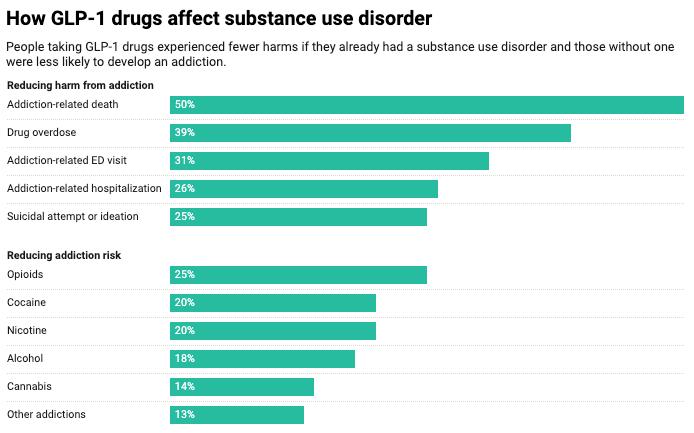
These drugs are surprisingly effective at fighting addiction, though research on relapses and long term effects is limited.
“The drugs also appeared to prevent addiction from developing in the first place. Among people with no prior substance use disorder, those taking GLP-1 drugs had an 18% lower risk of developing alcohol use disorder, a 25% lower risk of opioid use disorder and an approximately 20% lower risk of cocaine and nicotine dependence. Over three years, this translated to roughly six to seven fewer new diagnoses per 1,000 GLP-1 users. With tens of millions of people already using GLP-1 drugs, the reductions in deaths, overdoses, hospitalizations and new diagnoses could translate into thousands of prevented serious events each year.”
4. This City Turned Its Rooftops into a Climate Shield
Reasons to be Cheerful | 6 minutes

Green roofs can have a huge impact with the right approach.
“As a pioneer, Zürich has been studying the benefits of roof vegetation for over three decades. Green roofs cool the air, improve insulation, capture rainfall and filter pollutants. They reduce heat gain on the building below, lowering energy demand for cooling in summer and heating in winter. Zürich’s environmental office notes that extensive green roofs (those with a substrate thickness of up to 10-15cm) are on average 9°F cooler at the surface than those without vegetation, while intensive green roofs (those with a thickness of 15cm or more) can be up to 33.3°F cooler. Even two meters above the roof, air temperatures drop measurably.”
5. Balcony solar is taking state legislatures by storm
Canary Media | 4 minutes
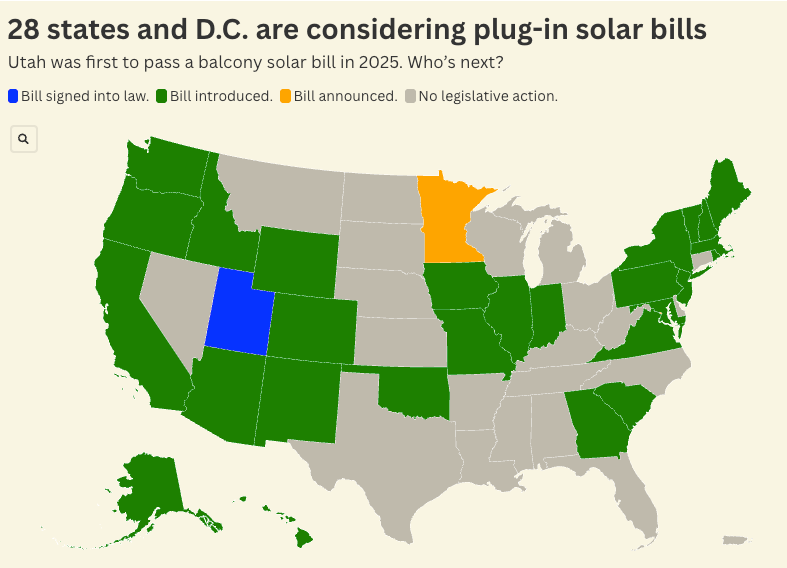
Meanwhile in the US: People all over the country have started to embrace balcony solar, despite federal politics that bolster fossil fuels at the expense of consumers.
“Plug-in solar is already booming in Europe. As many as 4 million households in Germany have installed the systems, which people can order through Ikea.But in the U.S., outside of Utah, the tech is stuck in regulatory limbo. While the systems aren’t illegal, utilities often require users to sign an interconnection agreement before plugging in solar — just as they would for a large rooftop array. And those agreements can require fees and take weeks to months to get. Utah did away with that interconnection requirement, so long as a nationally recognized testing laboratory certifies the solar device is safe to use. All the other legislation introduced since would do the same.”
6. Mapping Google’s Unmappable City
404 Media | 4 minutes

In the 2020s, only wealth can guarantee privacy.
“Parr’s experiment and documentary raises questions, of course, about who gets to have privacy in America. A wealthy enclave has set up the legal and surveillance infrastructure to be able to prevent being mapped. The rest of us, meanwhile, are subject to all sorts of surveillance by our neighbors and law enforcement.”
7. Happy Map
Pudding | 7 minutes
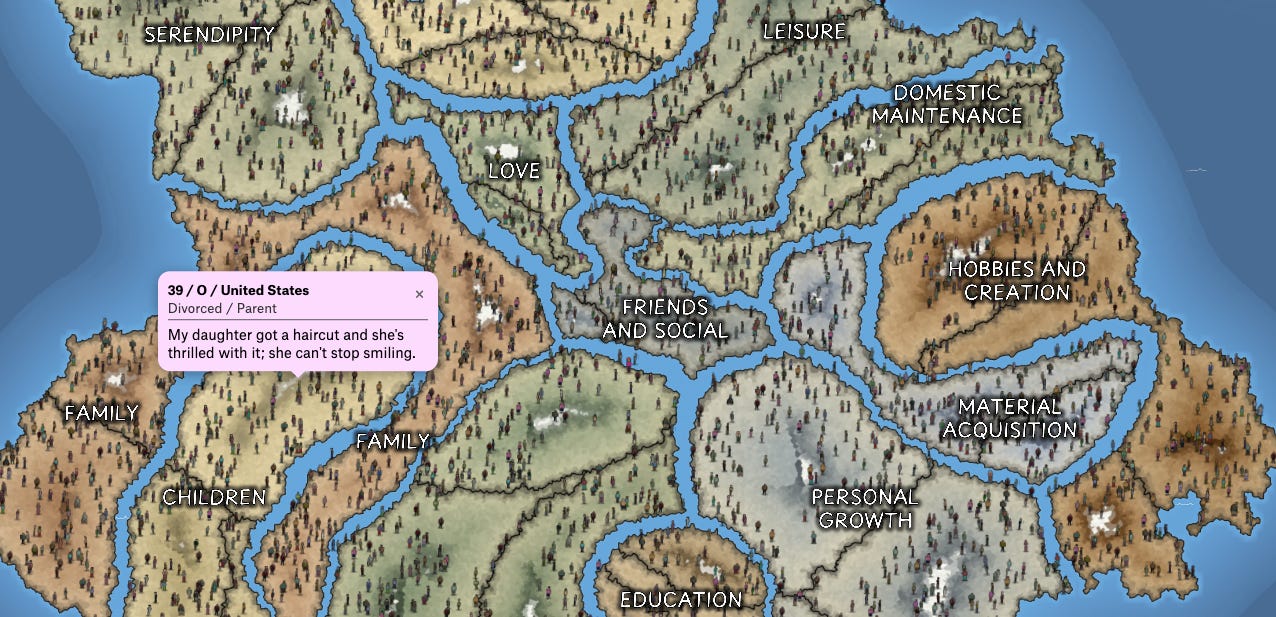
This interactive map let’s you explore people’s happy moments.
“The people you see here answered these questions as part of a 2017 research project. More than 10,000 people shared their happy moments.”
8. Apocalypse no: how almost everything we thought we knew about the Maya is wrong
The Guardian | 17 minutes

The Maya weren’t just a resilient and innovative ancient culture that rivaled classical Rome. They are a modern people, still fighting for their place in society.
“That is where the work of present-day archaeologists comes in. Until recently, the prevailing debate about the Maya centered around the question of why their civilisation collapsed. While scholars continue to study this question, an increasing number of archaeologists are now also asking: how did the Maya survive? The question addresses both their ancient – and modern – abilities to transform extremely challenging circumstances into enduring survival.”
9. How far back in time can you understand English
Dead Language Society | 16 minutes

This read is a journey into the past of the English language. Good luck!
“The English in which I write this paragraph is not the English of fifty years ago, and it will not be the English of fifty years in the future. Go back far enough, and English writing becomes unrecognisable. Go forward far enough and the same thing will happen, though none of us will be around to notice.”
10. A record number of objects went into space in 2025
Our World in Data | 2 minutes
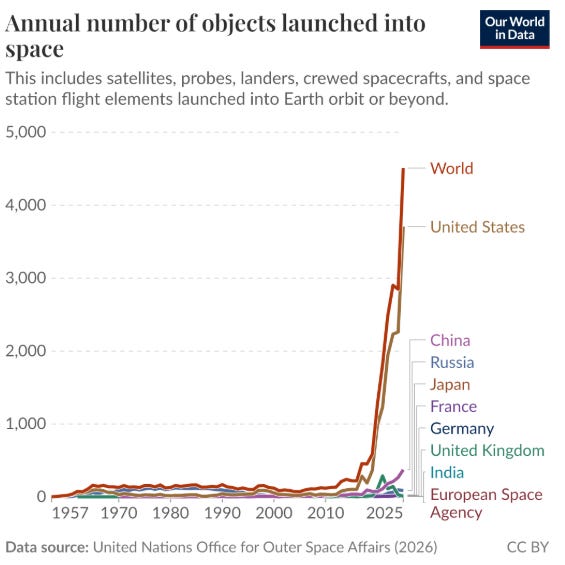
Great data as always. Space debris will be a growing challenge for ongoing exploration and research.
“The rapid growth of satellite constellations makes it possible to expand Internet connectivity, but it also increases concerns regarding space debris and the congestion of Earth’s orbital environment.”
Bonus: In Search of Banksy
Reuters 18 minutes

This article chronicles a winding investigation to identify the enigmatic artist.
“We had compiled a rich public record of all things Banksy: his past statements, companies connected to him, and excerpts from books or articles about him at various stages of life. By searching that data and cross-referencing it with other public records, we identified what we believed to be the name Banksy took. It is one of the most popular names in Britain, so common it helps him hide in plain sight.”
The World Processor is free, but pizza sure isn’t! If you like this issue, buy me a slice.
Nerd Notes
Dungeon Crawler Carl is taking the science fiction world by storm. An average guy and his ex-girlfriend’s cat are thrown into a violent interstellar game show. A fast, easy and fun read that’s heading into the mainstream and bound for the screen.

‘Til next month,
Garrett